Guide
AI Service Desk vs PSA and RMM: Do MSPs Need Another Tool or Intelligent Issue Resolution?
By NetZen AI
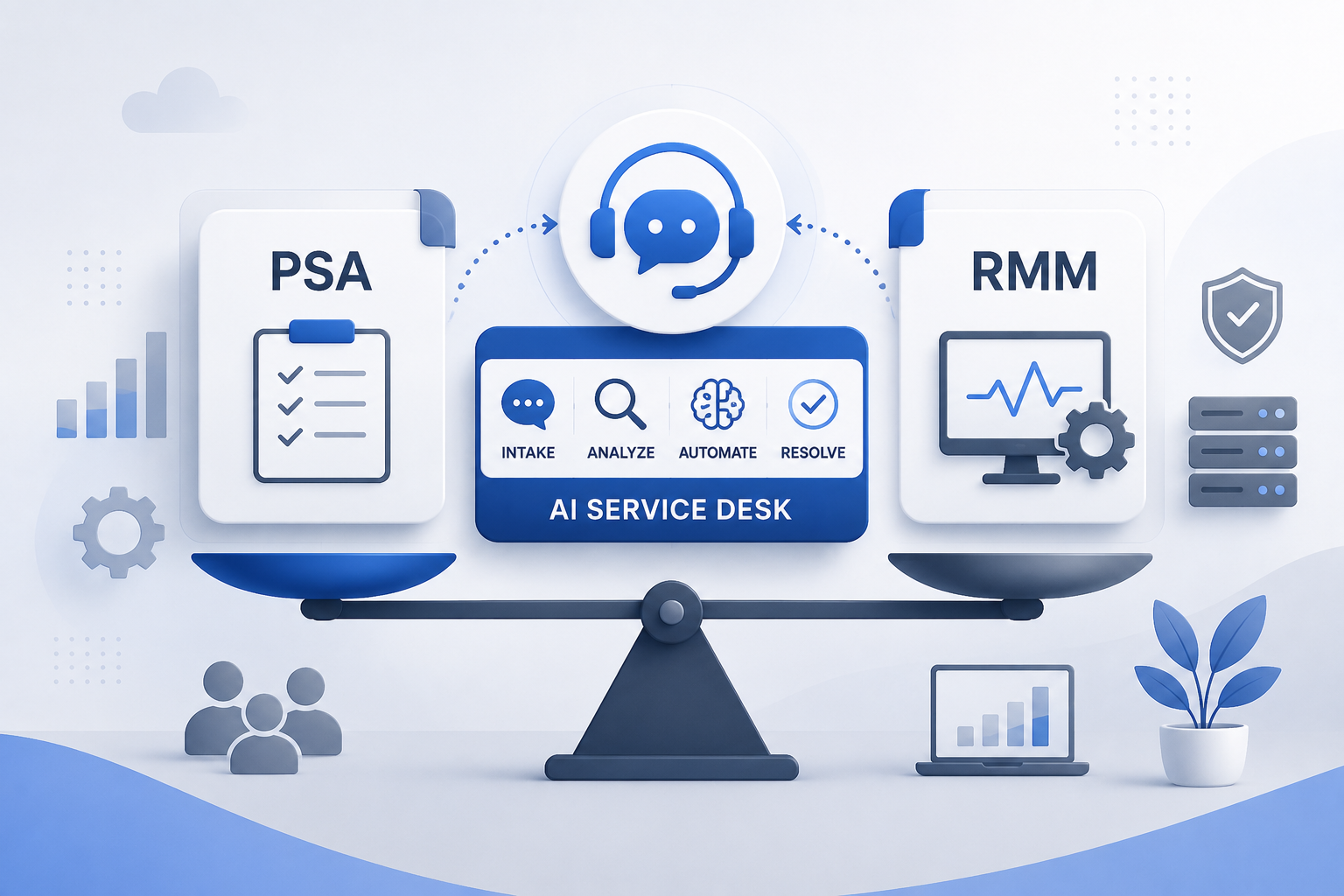
MSPs already use many tools to run their service operations. A PSA helps manage tickets, contracts, time tracking, billing, and reporting. An RMM helps monitor endpoints, run scripts, manage patches, and support remote device management.
Both tools are important. They helped define how MSPs operate today. But many MSPs still struggle with slow triage, missing ticket context, repeated Level 1 issues, and too much manual work.
This creates an important question. Do MSPs really need another tool, or do they need intelligent issue resolution?
The answer depends on the problem. If the problem is tracking work, a PSA can help. If the problem is monitoring devices, an RMM can help. But if the problem is resolving support issues faster, MSPs need a more connected workflow.
That is where an AI service desk fits.
An AI service desk does not only create or route tickets. It helps connect the support request, user context, endpoint diagnostics, automation, and technician next steps. The goal is not just better ticket management. The goal is faster and more intelligent issue resolution.
For MSPs, this shift matters because customers do not only want tickets logged. They want problems fixed quickly, clearly, and reliably.
What PSA Tools Do for MSPs
A PSA, or professional services automation tool, helps MSPs manage the business side of service delivery. It is often used for tickets, contracts, time entries, projects, billing, agreements, and reporting.
For many MSPs, the PSA is the operational backbone. It helps service managers understand workload, assign tickets, track SLAs, and connect support work to customer agreements.
This is valuable. MSPs need structure. They need records. They need reporting. They also need a clear way to connect service delivery with billing and client communication.
But a PSA is usually not designed to diagnose the technical issue behind a ticket.
A PSA may show that a user reported a slow laptop. It may show who owns the ticket and when it was created. It may show priority and status. But it may not show why the laptop is slow, which endpoint signals matter, or what action should run next.
That is the gap between ticket tracking and issue resolution.
What RMM Tools Do for MSPs
An RMM, or remote monitoring and management tool, helps MSPs monitor and manage endpoints. It can support device alerts, scripts, patching, remote access, inventory, and endpoint health checks.
RMM tools are valuable because they help technicians see what is happening across managed devices. They can show whether devices are online, protected, patched, or unhealthy.
An RMM can also help technicians run actions on endpoints. This can include scripts, updates, service restarts, or device checks.
But RMM tools are often separate from the support request. A user may report an issue in a ticketing system, while the device data lives in the RMM. The technician must manually connect the user complaint with the technical signals.
This creates extra work. It also creates delay.
A device alert is useful. A ticket is useful. But both become more valuable when they are connected around the actual user issue.
What an AI Service Desk Does Differently
An AI service desk uses artificial intelligence to improve how support requests are received, understood, diagnosed, routed, and resolved.
It can still support ticket intake and communication. But it should do more than create a ticket or summarize a message.
A strong AI service desk can collect better user context, classify the request, suggest priority, surface endpoint diagnostics, recommend next steps, and support approved automation.
For example, if a user says their laptop is slow, the AI service desk should not stop at ticket creation. It should help understand the issue. It may collect details from the user and check device health signals like CPU, memory, disk, battery, connectivity, recent errors, and system health.
This gives the technician a better starting point.
The value is not only AI. The value is that AI, diagnostics, automation, and technician workflow are connected around the support issue.
PSA vs RMM vs AI Service Desk
PSA, RMM, and AI service desk tools each answer a different question.
A PSA answers, “Who owns this work, and how is it managed?”
An RMM answers, “What is happening on this device?”
An AI service desk should answer, “What is the issue, what context matters, and what should happen next?”
MSPs need all of these answers. The problem is that these answers often live in different places.
A technician may read the ticket in the PSA, check the device in the RMM, message the user in Teams, search documentation, and then run a script from another system. This workflow can work, but it is fragmented.
Fragmentation creates tool switching. Tool switching creates delay. Delay increases technician workload and weakens the customer experience.
An AI service desk should reduce that friction by bringing the most useful context into one support workflow.
Why the Real Problem Is Not Another Tool
Many MSPs are cautious about adding new software. That makes sense. Service teams already work across many platforms.
The real problem is not that MSPs need more tools. The real problem is that support context is disconnected.
The ticket may explain what the user noticed. The RMM may show what the device is doing. The documentation may contain a known fix. The automation may live somewhere else. The conversation may happen in email, Teams, Slack, or a portal.
The technician must connect all of this manually.
That is the hidden cost.
When support context is disconnected, even simple tickets can take longer than they should. A user may say the internet is not working. The technician still needs to know whether it affects one device or many, whether WiFi is connected, whether DNS is failing, and whether the endpoint shows other issues.
An intelligent issue resolution workflow reduces this manual effort. It brings the support request, diagnostics, and action together earlier.
Why Intelligent Issue Resolution Matters
Intelligent issue resolution means moving beyond basic ticket tracking.
It means using context, diagnostics, AI assistance, and automation to understand and resolve issues faster.
This matters because most support teams do not lose time only because tickets exist. They lose time because tickets arrive incomplete. They lose time because technicians need to ask basic questions. They lose time because device context lives in another system. They lose time because common fixes are repeated manually.
Intelligent issue resolution helps close that gap.
It turns a vague request into a clearer technical picture. It helps technicians know what has already been checked. It helps identify likely causes faster. It also helps common issues move toward self service or approved automation.
For MSPs, this can improve technician productivity and user experience at the same time.
Where PSA and RMM Tools Still Matter
PSA and RMM tools still matter. This is not a simple replacement story for every MSP.
A PSA is useful for business operations. It helps manage agreements, tickets, billing, time tracking, and reporting. An RMM is useful for endpoint visibility, monitoring, patching, scripts, and remote actions.
The question is not whether these tools have value. They do.
The question is whether they fully solve the service desk workflow.
In many MSPs, the answer is no.
The service desk workflow sits between the user, ticket, endpoint, technician, and next action. That is where AI service desks can add value.
A well designed AI service desk should not create more complexity. It should reduce complexity by connecting the work that already happens across tools.
How NetZen AI Approaches This Differently
NetZen AI is an AI native service desk for MSPs and IT teams. It brings ticket intake, endpoint diagnostics, automation, technician assistance, and user communication into one connected workflow.
Instead of treating PSA and RMM as separate worlds, NetZen connects the support request with the device, the user, and the next best action.
For most MSPs, NetZen is enough. Ticketing runs in NetZen. If you want to keep some things in your PSA, you can continue using ConnectWise, Autotask, Halo, or Syncro for billing, contracts, and similar work.
This makes adoption more practical.
An MSP does not need to rip out every system on day one. It can start by improving the support workflow. It can connect intake, diagnostics, automation, and technician assistance around real support issues.
The goal is to help MSPs move from ticket management to intelligent issue resolution.
Learn more about the platform here: Platform.
Learn more about the company here: About NetZen AI.
For a broader overview, read: The Complete Guide to AI Service Desk for MSPs.
How AI Service Desks Reduce Tool Switching
Tool switching is one of the biggest hidden drains on technician time.
A technician may start in the ticket. Then they open the RMM. Then they check documentation. Then they message the user. Then they search past tickets. Then they run a script. Then they return to the ticket to update notes.
Each step adds friction.
An AI service desk can reduce this by bringing relevant context into one view. The technician can see the support request, user details, endpoint diagnostics, and suggested next steps together.
This does not mean every tool disappears immediately. It means the technician does not need to start every issue by hunting for context.
The service desk becomes more useful because it does not only hold the ticket. It helps explain what is happening.
Where Automation Fits
Automation is useful when it is safe, repeatable, and connected to context.
Many MSP tasks are repeated often. Technicians may collect logs, restart services, clear temporary files, check disk space, test connectivity, or apply known fixes.
If these actions are manual every time, they consume technician capacity. If they are automated without control, they can create risk.
The right approach is approved automation.
An AI service desk can recommend or trigger automation when the issue is common and the action is allowed. For higher risk actions, human approval should be required.
This balance matters for MSPs because they manage client environments. Speed is important, but control is just as important.
NIST’s AI Risk Management Framework is a useful external reference for responsible AI thinking. It encourages organizations to consider risk, trust, and governance when using AI systems.
What MSPs Should Look For
MSPs should look beyond the AI label. Many tools now claim to have AI. The real question is whether the AI improves service delivery.
A useful AI service desk should collect better intake details. It should connect support requests with endpoint diagnostics. It should support technician next steps. It should allow approved automation. It should also fit into existing workflows.
Security and control should be part of the design. MSPs should look for role based access, audit trails, approval controls, tenant separation, and data minimization.
The service desk should also improve communication. Users should be able to ask for help through the channels they already use. Technicians should receive enough context to act faster.
PeopleCert’s ITIL service desk practice is a helpful reference for service desk thinking. It describes the service desk as an important communication point between service providers and users.
For MSPs, the practical lesson is clear. The service desk is not only a ticket queue. It is a core part of the service experience.
Common Mistakes MSPs Should Avoid
One common mistake is assuming a PSA alone solves the support problem. A PSA is important, but it may not diagnose the issue.
Another mistake is assuming an RMM alone solves the support problem. An RMM can show device data, but it may not connect that data to the user request.
A third mistake is adding AI as another disconnected tool. This can create more complexity if it is not tied to the support workflow.
A fourth mistake is automating too much too soon. MSPs should start with safe, common, and approved actions.
A fifth mistake is ignoring the technician experience. If technicians still need to jump across many screens, the workflow is not truly improved.
The best approach is to start with the issues that slow the team down most. These often include vague tickets, repeated Level 1 requests, slow devices, internet issues, and common access problems.
FAQ
What is the difference between PSA, RMM, and an AI service desk?
A PSA manages service operations such as tickets, contracts, billing, time tracking, and reporting. An RMM monitors and manages endpoints. An AI service desk connects the support request, user context, endpoint diagnostics, automation, and technician next steps.
Does an AI service desk replace PSA and RMM tools?
For most MSPs, NetZen is enough. Ticketing, diagnostics, and technician work run in NetZen. If you want to keep some things in your PSA, you can continue using it for billing, contracts, and similar operations. RMM can stay where you already use it for device management.
Why do MSPs need an AI service desk if they already have a PSA?
A PSA helps manage the ticket, but it may not diagnose the issue. An AI service desk helps collect context, surface diagnostics, suggest next steps, and support approved automation.
Why do MSPs need an AI service desk if they already have RMM?
An RMM monitors devices, but it may not connect device context to the user request. An AI service desk helps connect the ticket, endpoint diagnostics, and support workflow.
Is an AI service desk just another MSP tool?
It should not be. A strong AI service desk should reduce tool switching by connecting intake, diagnostics, automation, and technician assistance in one workflow.
How does NetZen AI reduce tool sprawl?
NetZen brings ticket intake, endpoint diagnostics, automation, technician assistance, and user communication into one connected platform. This helps technicians work from clearer context instead of jumping between disconnected tools.
Can NetZen AI work with existing PSA tools?
Yes. For most MSPs, NetZen is enough. If you want to keep billing, contracts, or similar work in ConnectWise, Autotask, Halo, or Syncro, you can.
What does intelligent issue resolution mean?
Intelligent issue resolution means using AI, diagnostics, automation, and technician guidance to understand and resolve support issues faster. It moves the MSP beyond basic ticket tracking.
Conclusion
PSA and RMM tools have helped MSPs run service operations and manage endpoints for years. They still have value.
But the support challenge has changed.
MSPs now need faster intake, better context, less back and forth, safer automation, and clearer technician workflows. That requires more than ticket tracking or device monitoring alone.
An AI service desk helps connect the support request, user context, endpoint diagnostics, automation, and next steps into one workflow.
For MSPs, the question is not only whether they need another tool. The better question is whether their current workflow helps technicians resolve issues faster.
NetZen AI is built around that shift.
It helps MSPs move from fragmented tools and ticket management toward intelligent issue resolution.
Ready to see how an AI service desk can help your MSP? Start a 30-day free trial.